Your social media manager drops a proposal on your desk: spend $20,000 on a UGC creator program, or put the same budget toward two mid-tier influencer campaigns. Both promise engagement, both promise reach, and both come with a deck full of metrics that look compelling on paper. So which one do you choose?
For consumer brands, this decision shows up constantly. UGC and influencer marketing have merged into a blurry middle in many agency pitches, but they operate on fundamentally different mechanics. Choosing the wrong one does not just waste budget; it produces content your audience ignores or traffic that never converts.
This guide breaks down what each strategy actually delivers, when to use each, and how to allocate budget between them intelligently.
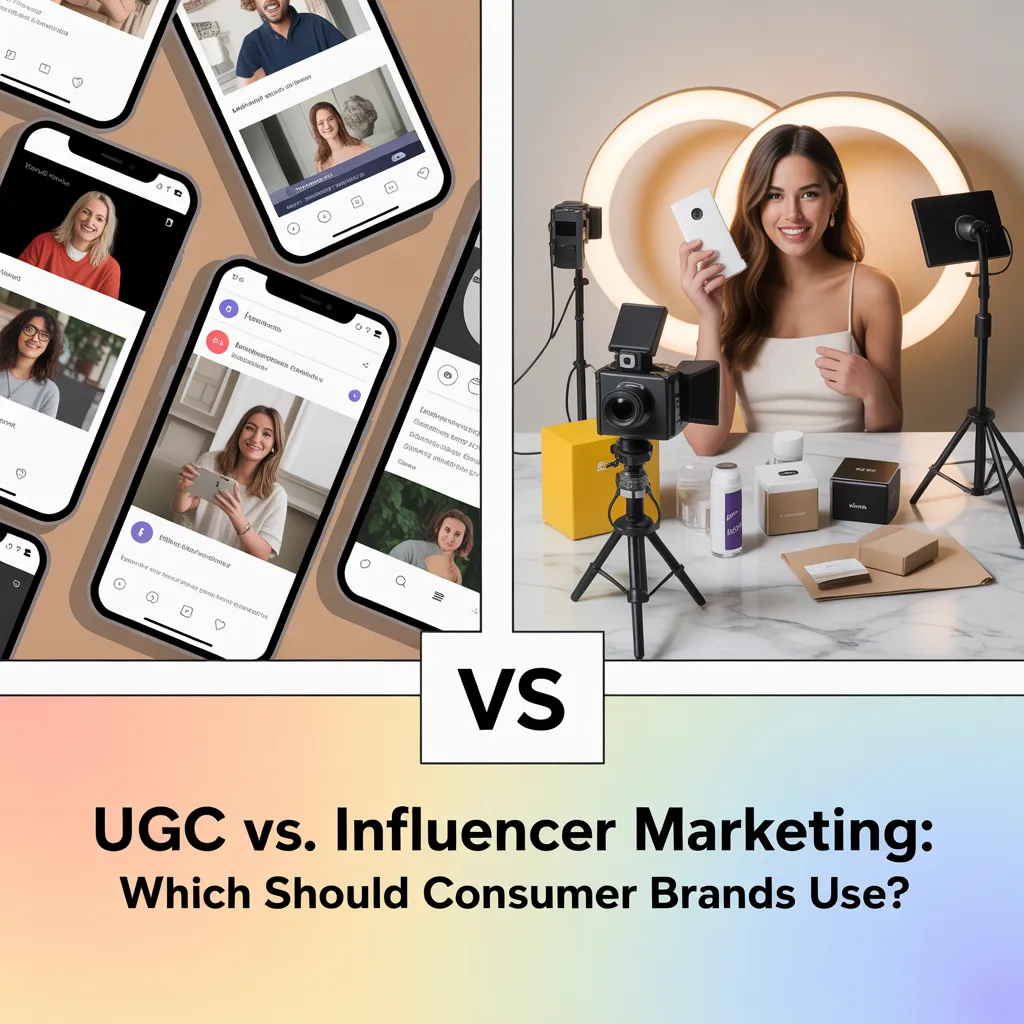
User-generated content is any content created by real customers or paid content creators that mimics organic customer content. In modern brand strategy, UGC typically refers to short-form videos, photos, and reviews produced by creators who shoot in an authentic, unpolished style for use in paid ads, email, website pages, and social feeds. The brand pays for the asset, owns it outright, and controls where it runs.
Influencer marketing places your product or service in front of an existing audience through a creator who has built trust with that audience. The brand pays for access to that audience, not just the content. The influencer posts natively from their account, and the content lives on their channel, not yours.
The core distinction: UGC is a content production model. Influencer marketing is a distribution model.
UGC solves a volume and cost problem. Producing high-quality creative for paid social is expensive when you rely on traditional production, and ad fatigue means you need to refresh creative constantly. UGC creators produce authentic-looking assets at a fraction of studio production costs, and because the format mimics organic content, it performs differently in the feed.
UGC works particularly well when:
The advantage of UGC is ownership. You control usage rights, placement, and longevity. Content can be repurposed across email sequences, landing pages, Amazon listings, and Meta and TikTok ad accounts for as long as it performs.
Influencer marketing solves a discovery and trust problem. When your brand is unknown in a category, or when you are entering a new market or targeting a new demographic, paid ads and SEO take time to build credibility. An influencer who has spent years earning trust with a specific audience can accelerate that process significantly.
According to the Influencer Marketing Benchmark Report 2026, influencer content generates an average engagement rate of 3.86%, compared to 1.21% for brand-created content on the same platforms. That gap reflects the trust differential, not just algorithmic preference.
Influencer marketing works particularly well when:
The limitation is that the content typically lives on the creator’s channel, performance is harder to isolate, and the relationship requires careful vetting to protect brand safety. For a deeper look at how to vet and select the right partners, see our guide to the best micro-influencer agencies for consumer brands.
Before choosing between the two, most consumer brand teams should look at three practical factors:
UGC gives you a perpetual, transferable asset. Influencer content typically grants limited usage rights for a defined period, often 30 to 90 days, unless you negotiate extended whitelisting. If you want to run an influencer’s video as a paid ad, you need explicit written permission and usually pay an additional licensing fee.
UGC deployed in paid channels gives you clean attribution through Meta Ads Manager, TikTok Ads, or Google. You can see exact ROAS, CPE, and conversion rates by creative. Influencer posts measured organically rely on creator-reported data, affiliate codes, or UTM links, all of which have tracking gaps.
According to the Influencer Marketing Benchmark Report 2026, the average cost per engagement for UGC-style paid ads is $0.20, compared to $0.33 for organic influencer posts without whitelisting. The paid format converts at a lower cost when the creative is strong.
UGC campaigns can be turned around in 7 to 14 days. You brief creators, review, and deploy directly to your ad account. Influencer campaigns require negotiation, content approval, scheduling around the creator’s calendar, and compliance review, which typically takes 3 to 6 weeks from brief to post.
Choose UGC as your primary tactic when your brand already has some market recognition and your main challenge is converting aware consumers into buyers. UGC accelerates the bottom of the funnel.
Specific scenarios where UGC consistently outperforms:
A well-run UGC program also builds a reusable creator roster. Brands that invest in ongoing UGC relationships reduce per-asset costs over time and develop creators who understand the product deeply, which improves content quality.
Choose influencer marketing as your primary tactic when brand recognition is the limiting factor. If potential customers have never heard of you, and your paid social CAC is unsustainably high because no one trusts your brand enough to click, influencer endorsement can reset that dynamic faster than any other channel.
Specific scenarios where influencer marketing is the clearest fit:
According to Thunderbit’s 2026 analysis of influencer marketing ROI, brands that use influencer campaigns for awareness report $5.78 ROI per dollar spent on average, with the highest returns coming from micro-influencers in the 10,000 to 100,000 follower range due to stronger audience trust and lower fees.
Most consumer brands benefit from running both, but the ratio should shift based on where you are in your growth stage.
Early-stage brand (under $5M revenue, limited recognition): Allocate 60 to 70% of social content budget toward influencer marketing for awareness, and 30 to 40% toward UGC for ad creative and conversion content.
Growth-stage brand ($5M to $50M, building a customer base): Balance shifts to roughly 50/50. Use influencer campaigns to maintain cultural relevance and enter new segments while running aggressive UGC-powered paid social.
Scaled brand (over $50M, strong category recognition): UGC often becomes the primary creative engine for performance marketing, with influencer used selectively for launches, brand partnerships, and maintaining authenticity at scale.
These are starting points, not rules. Category, margin, and your current conversion rate all affect the right ratio. What matters most is tracking both against actual business outcomes, not just engagement.
The most effective consumer brands do not treat UGC and influencer marketing as separate budgets. They build a flywheel where each feeds the other.
Influencers create awareness and generate content. That content, with usage rights secured, becomes UGC for paid social. Paid social drives conversions, and the purchase data informs which creator angles and audiences to target next. The brand brings this data back to influencer briefs, improving future campaign performance.
Executing this flywheel requires an agency that manages both PR and digital under one roof, with clear data sharing between the influencer team and the paid media team. When those functions are siloed, brands consistently underperform because influencer insights never reach the media buyers and paid creative never informs the influencer brief.
Jive PR + Digital builds integrated campaigns that connect influencer strategy, UGC production, and paid social into a single performance loop. If your brand is managing these as separate vendor relationships, that is likely where budget is leaking.
Is UGC or influencer marketing better for a new product launch?
For a new product launch, influencer marketing typically delivers more value in the first 4 to 6 weeks because it generates awareness and social proof simultaneously. After launch, UGC becomes the primary engine for scaling paid social and converting that awareness into purchases.
Can I use influencer content as UGC in my paid ads?
Yes, but only if you negotiate usage rights in the initial creator agreement. Standard influencer contracts do not include paid amplification rights. Always clarify usage rights, duration, and platforms in writing before the campaign begins. Whitelisting, where the brand runs ads directly from the creator’s handle, requires an additional arrangement.
What is the difference between a UGC creator and an influencer?
A UGC creator produces content in an organic, customer-style format for brand use. They do not need an audience because the content runs on the brand’s channels, not theirs. An influencer has a built audience and is hired to post to that audience. You pay for the creator’s output in the first case, and for the creator’s reach in the second.
How much should a consumer brand spend on UGC vs. influencer marketing?
There is no universal ratio, but a practical starting point for a growth-stage consumer brand is 50% influencer for awareness and 50% UGC for paid performance. Adjust based on your current CAC and how much brand recognition you need to build versus conversions you need to drive.
What metrics should I track for influencer marketing vs. UGC?
For influencer marketing, track reach, engagement rate, story views, and downstream traffic using UTM parameters or affiliate codes. For UGC in paid channels, track ROAS, CPE, conversion rate, and creative fatigue score. The two strategies call for different measurement frameworks, and mixing them produces misleading results.
Which works better on TikTok, UGC or influencer marketing?
Both work on TikTok, but for different reasons. UGC deployed through TikTok Ads (particularly Spark Ads) performs well for conversion because the format is native and non-intrusive. Influencer partnerships work well for organic discovery and cultural traction. TikTok’s algorithm rewards content quality and relevance over follower count, which means well-briefed micro-influencers often outperform larger creators with disengaged followings.
UGC and influencer marketing answer different questions for consumer brands. UGC asks: how do we convert people who already know us? Influencer marketing asks: how do we reach people who do not? Most brands need answers to both.
Jive PR + Digital builds integrated campaigns that connect influencer strategy, UGC production, and paid social into a single performance loop. If your brand is ready to stop managing these as separate tactics and start running them as a coordinated system, get in touch to talk through what an integrated PR and digital approach would look like for your brand.